Who knew? I thought it would be a bunch of wonks, Star Wars alumni, Tolkien freaks, time travelers, anti-Indiana Joneses, Outcasts of the Curious Anachronism Society and RenFest drop outs. Well shame on me, although I'm a tad disappointed to see that they seem to look alot like me, except for the manly men with earnest expressions and one or two with Merlin beards. At least here in downtown Portland, it isn't a Summer of '69 reunion either attending the Anthropology Department's "First Thursday" Lecture event at 4pm yesterday afternoon. Of course I was going to go, and it has nothing to do with the extra credit essay, because the topic was establishing a Cultural Resources Preservation Program for the City of Portland, to enforce the national, state, county and municipal historic sites' laws as well as bringing it to a higher profile in the community.
Honestly, I was stunned. You mean Portland doesn't have this already? I thought. You've got to be kidding me.
The presenter was Wendy Ann Wright, a PSU student in the Anthropology department, a Powells Books alumna, mom, and passionate member of Sam Adams' staff at City Hall. OMG!!
What better person to catalyze this idea in the city, and she had a great slide presentation of the research she's done in other cities nationally, to find models that are community-based and effective already. Again, I sat there looking at her slides of St. Mary's Academy Wall demolition that she may as well have downloaded from my blog, as well as hurried excavations of privies and Chinese cemetery graves with a row of bulldozers and backhoes hovering in the background.
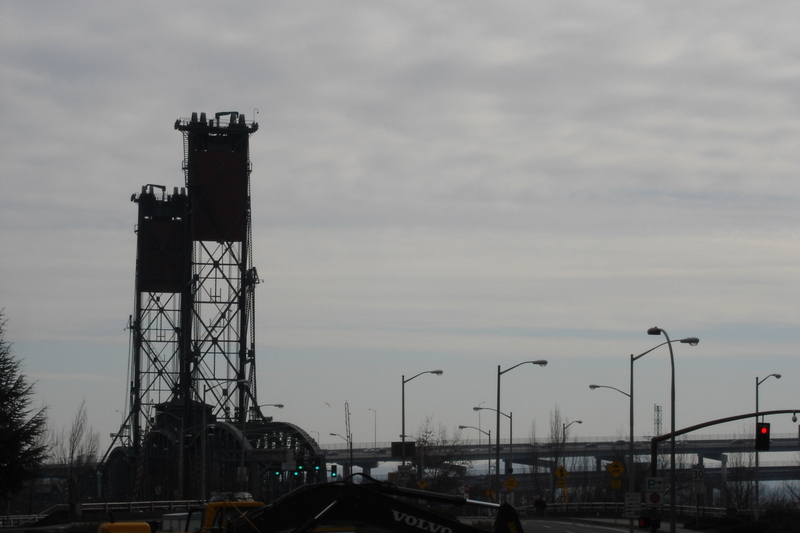
Portland doesn't have this in place already? I can't believe this! When she concluded, my hand shot up. "Hi, I'm really uninformed about the whole City permitting process, but everyday I see the progress of the building project at the base of the Hawthorne Bridge, and they're already 50 feet down---before the contractor started digging, he had to find out about gas lines, water lines,
how strong the soil barrier is between the hole and the river---I would think historic maps of municipal locations are available to check this just like the gas and water companies survey and OK going ahead with excavating, right? Couldn't a City of Portland Archaeologist or Historic Site Manager Office be layered in here at this point so at least within the city limits sites aren't just plowed up?"
Well, she mentioned the standard fire maps, and archived city maps, but no, there isn't really anything like this in Portland at this time, it would be a budget issue certainly.
An older gentleman stood up. He was concerned that there was a punitive attitude coming off of archaeologists and site preservationists that would actually have the opposite effect of discouraging people from coming forward with asking for site assistance if an artifact showed up in a shovel of dirt or their basement bricks collapse and there's old bootlegger paraphrenalia falling onto the floor. Why couldn't the utilities and industrial corporations be asked to underwrite some of these efforts and also cooperate with the city in recovering some of their own industrial history and be seen as caring about the community preservation movement instead of being told to absorb the time and costs of investigating sites all over the city? He started out seeming a bit hostile to Wendy's anti-looting attitude that makes all collectors and antique markets suspect, but she was able to agree with him and turn his question into an approach almost everyone could agree with. She said there was an African American Art exhibit that Sam Adams' office was involved in that had had an antique bottle collector involved, but he pulled out after getting some flack from the archaeologists in town about his collection being "looted", which in strict trade terminology means removed from its historical context (or dump pit). It is a comment on we everyday townsfolk that most of us need to be educated that saving a cloudy antique bottle (it's blue and says 'poison', cool!!) from your backyard compost pile of 103 years ago constitutes "looting". But it is. Strictly speaking. Even if you own the property.
This is where the contact sport part comes in.
Needless to say, in Wendy's research to find a working preservation model that has widespread and cooperative community involvement, she finds that there are plenty of struggles with individuals' and commercial property rights when it comes to designating something 'historic' or a 'cultural resource' , and different cities have varying levels of success with this issue. She mentioned Alexandria, VA and Vancouver, WA as two cities with viable programs and great community involvement and support. These agencies get the kids involved with introductions to archaeology with a "kids dig"; artifact copies that the kids get to use methods of excavation to "find" and analyze. Also, many Native American Nations are active in community awareness and education to preserve sites and ways of life, often coordinating with municipal and county agencies to work with the public and commercial interests. Often, she said, there are laws in place already that are poorly enforced or thought of as arcane, and educating officials about these laws would be a place to start with raising preservation with the public.
There's already a faint sound in my head, "You should do this, you love Portland so much, what a great project this would be to get involved with and help launch!" I haven't had a huge ambition in a few months, it's about time to have a new one, isn't it? Halfway through my first term, after 25+ years out of school, and already I'm the department expert in my own delusional brain. Too funny, isn't it? And the fact that these "First Thursday" Anthropology lecture attendees are about my age, already have my interests, and go to a pub afterwards to eat and drink and talk shop would be the perfect arm-twister to get me to keep going. And earning extra credit. And blogging about it. Until maybe I finally dive in and present Sam Adams with a plan.